
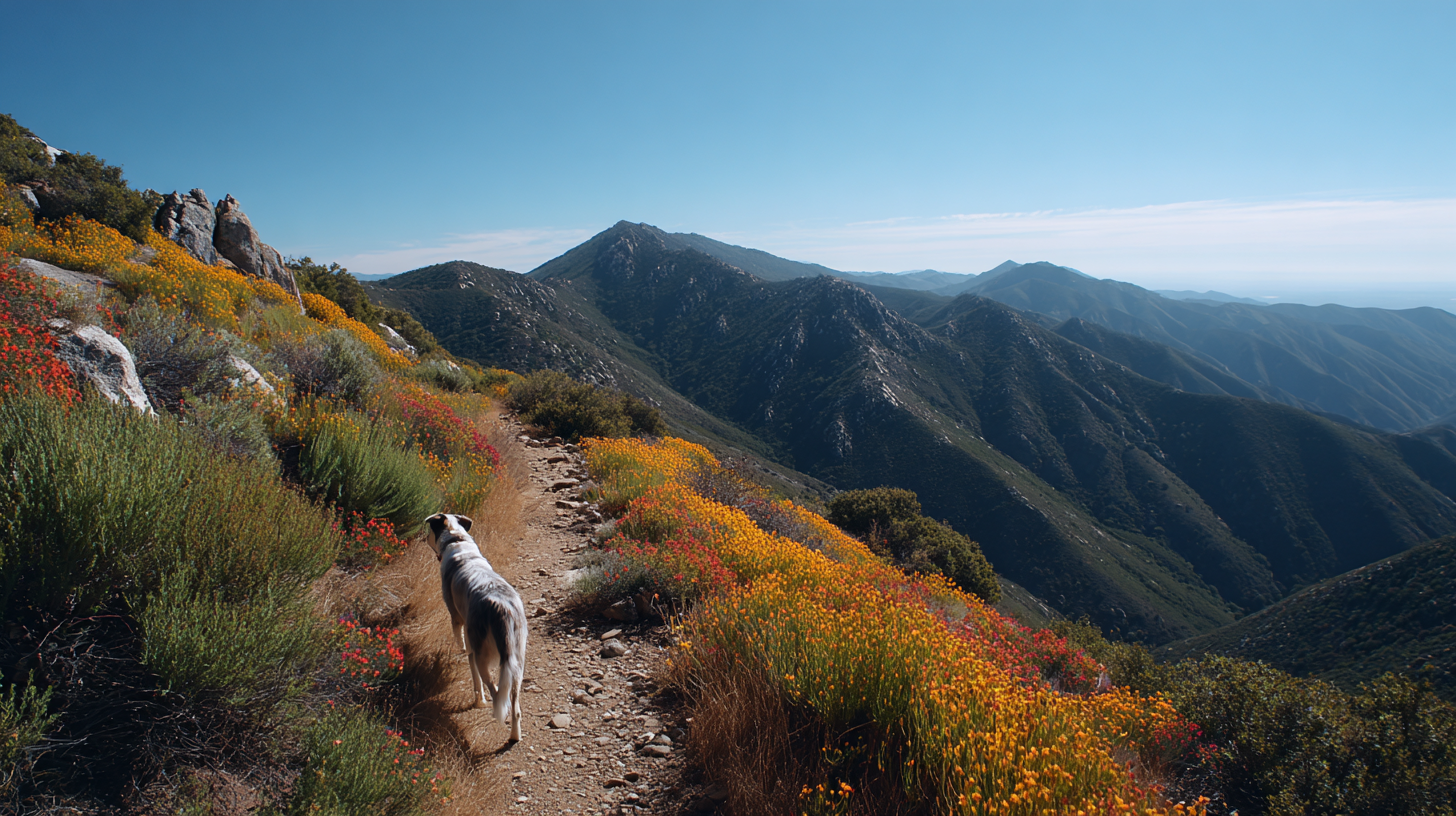
Dawn in the Sierra Nevada is a quiet, pink-tinted secret. My dog, Scout, knows it before I do. She thumps her tail against the tent wall, nose wedged into my sleeping bag, reminding me why we slept at the edge of a dirt road: somewhere uphill, there’s a little-used trail that will belong to us for the next few hours.
Ask most people about hiking with dogs in California and they picture crowded coastal paths or famous national parks with stern “no pets on trails” signs. Yosemite, Sequoia and other marquee parks generally confine dogs to campgrounds, paved walkways and parking lots. The real freedom lies elsewhere, in a patchwork of national forests, regional parks and lesser-known preserves that lace the state’s mountain ranges from Carmel Valley to Big Bear.
One of the gentlest introductions sits just inland from the Monterey Peninsula. Garland Ranch Regional Park rises from the floor of Carmel Valley into the northern flank of the Santa Lucia Mountains, the Carmel River looping through its lower canyons. Dogs are welcome on most of the park’s trails, and in designated areas they may go off leash as long as they stay under solid voice control. Locals treat the place like a wilderness dog park with trail maps, trading gossip at the trailhead before fanning out into oak woodland and chaparral. The climb to Snively’s Ridge is the park’s signature effort, roughly 6½ miles round trip and nearly 2,000 feet of elevation gain, with views that stretch from the valley to Monterey Bay. In summer, inland heat can be punishing, so early starts and plenty of water matter for both humans and dogs.
Far to the north, near the town of Mount Shasta, Black Butte juts above Interstate 5 like a pile of toppled boulders. A narrow path zigzags up its shoulder for about 5.2 miles round trip and 1,800 feet of gain. Dogs are allowed but must stay leashed, and the upper switchbacks cross loose volcanic rock that can be hard on paws. On clear days, the summit view takes in snowcapped Mount Shasta, the Trinity Alps and dark forest folding away in every direction. It’s a hike best saved for late spring through fall, when snow has melted but wildfire smoke, in recent years, hasn’t yet arrived.
On the Eastside of the Sierra, high above Highway 395, Little Lakes Valley offers a softer kind of grandeur. The trail begins near 10,000 feet in Rock Creek Canyon and meanders past a chain of alpine lakes beneath granite walls. The grade is modest, and hikers can turn around at any lake they choose, making the outing anything from a short leg-stretcher to an 8-mile day. Leashed dogs trot from tarn to tarn, splashing in creeks and dozing in the shade of whitebark pines. The trade-offs are altitude and season: snow can block the access road into early summer, thunderstorms build quickly on hot afternoons, and thin air can leave both people and pets a little breathless.
Lake Tahoe hardly sounds like a secret, but some of its best dog hiking hides in plain sight. Van Sickle Bi-State Park climbs directly from the casinos at Stateline into quiet pine forest, offering one of the quickest routes to a big Tahoe vista. The main trail reaches a lookout over the lake in about a mile, then continues toward the Tahoe Rim Trail on a series of dusty switchbacks. Leashed dogs are welcome throughout the park, which straddles the California-Nevada line, and the proximity to town makes it a natural morning or sunset outing before the beach crowds arrive.
In Southern California, where summer heat bakes the valleys, the coolest dog days are in the San Bernardino Mountains. Near Lake Arrowhead, Heaps Peak Arboretum offers an easy 0.8-mile loop through firs and dogwoods, with water bowls and interpretive signs that make it feel as much like an outdoor classroom as a trail. Just up the highway, the Children’s Forest Exploration Trail runs several miles into the national forest, climbing to wide views above the Inland Empire. Storm damage has closed sections of that route at times, so it is worth checking conditions; when it is open, leashed dogs are welcome and shade is plentiful.
Towering above nearby Big Bear Lake is Sugarloaf Mountain, a 9,952-foot peak that sees far fewer visitors than its status suggests. The Sugarloaf National Recreation Trail runs roughly 11 to 12 miles round trip and climbs about 3,300 feet. It is a stout, all-day hike, with no water and little shade on the upper ridges, but leashed dogs are allowed and hardy locals treat it as a training ground. The summit itself is forested and viewless; the real payoff is the solitude and the glimpses, on the way up, of the San Gorgonio Wilderness rolling south in blue layers.
Not every mountain range is fair game for four-legged hikers. In the Santa Rosa and San Jacinto Mountains National Monument above the Coachella Valley, dogs are barred from most backcountry trails to protect endangered Peninsular bighorn sheep. Only a few short, developed paths allow leashed pets. The message is clear: enjoy the views from dog-friendly edges of the monument or head instead to nearby national forest lands, where many routes remain open to pups under leash laws.
That patchwork of rules is the reality of dog hiking in California. The reward for navigating it is a version of the state that never makes the postcards: granite under your boots, dust on your dog’s paws and a shared sense that, at least for one long walk, the mountains are yours. By the time you rattle back down the dirt road to camp and the sky fades from pink to indigo, the only sound in the back seat is steady breathing. Scout is asleep, dreaming of whatever waits around the next bend in the trail.