
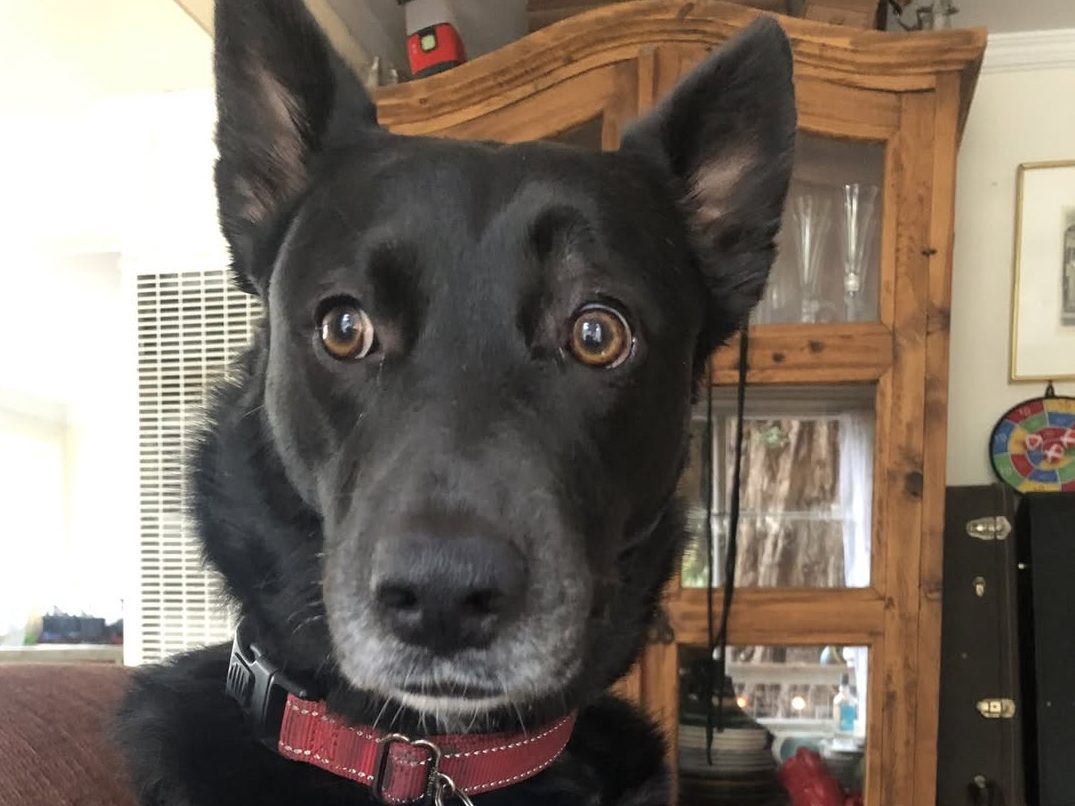
Skylar weighs about fifty pounds, give or take the wiggle factor. She’s the kind of dog who can mime a full emotional arc just by adjusting her eyebrows. And as far as anyone can tell, she’s a German shepherd–border collie mix, which really just means two overachiever breeds conspired to build a dog who’s ready to manage a project team.
She showed up on the streets of Turlock one spring, maybe a year old, already a mom. Too young for any of that, but life doesn’t ask dogs for permission. She moved with that light, springy gait, ears swiveling, brain clicking through possibilities. A dog made for motion and connection, the sort who would thrive on a ranch if you handed her a whistle and a clipboard.
Then it all turned. One minute she was trotting down a sidewalk like she had appointments. The next she was behind chain link at a high-kill shelter, the fluorescent lights humming, the air thick with barking and anxiety. No villain here; the staff did their best. They’re always doing their best. But shelters run on math. Too many dogs coming in, not enough dogs going out. Space is finite. Time is finite. And when both run out, options disappear.
Skylar waited. That’s the part nobody sees when they scroll past those intake photos. She waited while the clock ticked in a room full of noise and fear.
Meanwhile, somewhere in the Bay Area, lived the woman I can only describe as a professional dog rescuer without the paycheck. Every region has one. She’s the person who looks at grainy shelter images and somehow hears a story. She’s juggling fosters, coordinating meetups, driving across counties because a dog’s time is down to hours. Her minivan smells like blankets and kibble and hope.
She saw Skylar’s photo. And in whatever rescue sixth sense these people have, she knew this dog wasn’t finished yet. So she drove to Turlock, gathered the paperwork, and walked Skylar out of that building with minutes to spare.
Skylar became part of an East Bay rescue pack, about ten dogs deep, a joyful mashup of personalities and histories. A loose little community rebuilt out of bad luck and second chances. She learned house rhythms, discovered toys, developed strategies for convincing humans she deserved extra treats. In that crowd, she found her footing.
And that’s where we found her. Online, of course. Not even in a perfect adoption photo. Her ears looked too big, her fur a little chaotic, her eyes saying, “I’m smarter than you think, and also I may borrow your sandwich.” We knew instantly.
Five years later, she carries more white around her muzzle, like someone dusted her with powdered sugar. The spirit is unchanged. She stays demanding, playful, protective, occasionally bossy, and very sure we exist to carry out her strategic plans. She is family by declaration. Hers, not ours.
This brings us to the question I always end up answering: What’s the difference between a rescue and a shelter?
A shelter is a place. A building. Often city or county run. It takes in whoever arrives. Strays, owner surrenders, lost dogs, complicated dogs. Shelters stabilize. They give animals food, water, vaccines, safety, a temporary stop between crisis and whatever comes next. But their resources are stretched. Their decisions revolve around capacity. They are doing triage in real time.
A rescue is a network. Not a building, a community. Volunteers, fosters, transporters, adoption counselors. People with day jobs who somehow carve out hours to save animals. Rescues pull dogs from shelters and place them into foster homes where someone can learn their quirks, calm their fears, and introduce them to sofas.
Shelters give dogs numbers. Rescues give them biographies.
Shelters keep dogs alive long enough to be seen. Rescues give them the runway to become themselves again.
Skylar needed both. The shelter held her until someone could notice her. The rescue stepped in when the clock got loud. And now she lives the life she should have had all along, curled into our routines, shaping our days, protecting us, entertaining us, and occasionally bossing us around like she owns stock in the household.
The long way home rarely looks like a straight line. But when a dog like Skylar finally reaches it, you recognize it instantly.