
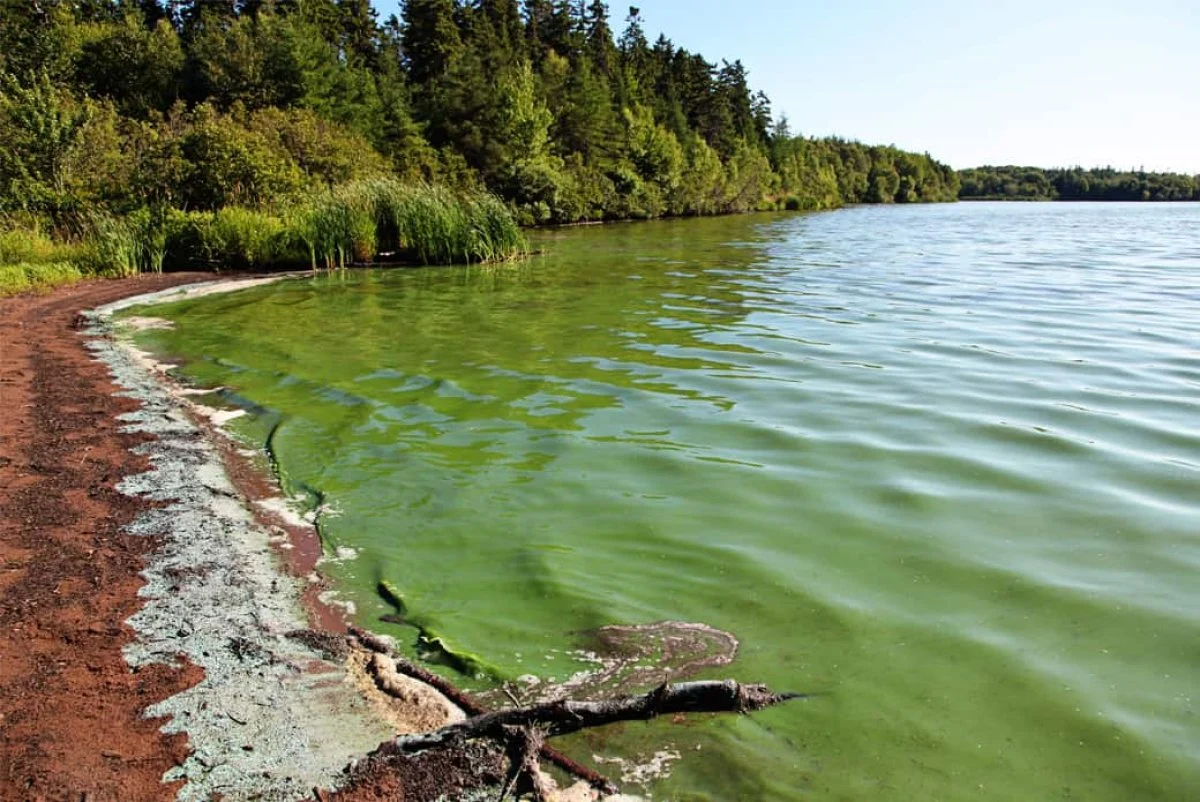
Short answer: Toxic algae blooms in California waters can kill a dog within minutes to hours. There is no antidote. The Pet Poison Helpline notes that “very small exposures, such as a few mouthfuls of algae-contaminated water, may result in fatal poisoning.” Peak risk is late summer through early fall, and California’s HAB Reports Map at mywaterquality.ca.gov is the authoritative place to check before you go.
This is the danger that ambushes responsible dog owners every summer. Posie, a 3-year-old Golden Retriever, died on the Russian River over Labor Day weekend 2015 after a routine float trip. Humboldt County has documented 12+ dog deaths since 2001 across the North Coast lagoons and rivers. Here is what California-specific science actually says — and how to keep your dog out of the next case report.
What HABs are and why dogs are uniquely vulnerable
Harmful algal blooms (HABs) are blooms of toxin-producing microorganisms. In freshwater, the danger is cyanobacteria — “blue-green algae” — which are not actually algae but photosynthetic bacteria, per the EPA. Of about 2,000 known cyanobacteria species, only ~80 produce toxins, but as VCA notes, “it is impossible to determine whether a bloom contains toxins simply by looking at it, so all blue-green algae blooms should be considered toxic until proven otherwise.”
Dogs are uniquely vulnerable for three reasons:
- They drink while swimming. A few mouthfuls is enough.
- They lick their fur after. Toxin-laden water concentrated on coat → ingested grooming dose.
- They are smaller than people. Per Humboldt County DHHS: “Dogs and children are most likely to be affected because of their smaller body size and tendency to stay in the water for longer periods of time.”
Cattle, wildlife, and people can be killed by HABs too — but the vast majority of California’s documented HAB-related fatalities are dogs.
The three cyanotoxin classes — and what each does
Per VCA Hospitals and the Pet Poison Helpline, three toxin classes matter:
- Neurotoxins (anatoxin-a): Onset within 60 minutes. Causes muscle stiffness, inability to move, shaking, convulsions, drooling, vomiting, diarrhea, fluid in lungs. Death from respiratory paralysis “within minutes to hours” per Pet Poison Helpline. Anatoxin-a’s nickname is “Very Fast Death Factor (VFDF)” — a label that came directly from how rapidly it kills mammals.
- Hepatotoxins (microcystins): Onset within four hours. Causes vomiting, diarrhea (possibly bloody), pale gums, low blood sugar, clotting failure, jaundice, seizures, disorientation, coma, shock. Death from liver failure “within days.”
- Dermatotoxins (incl. cylindrospermopsin family effects): Cause itching, redness, skin blistering within hours of contact.
The AVMA’s blunt summary: HAB ingestion “can lead to clinical poisoning and often death within minutes, hours, or days” in pets, livestock, and wildlife.
Symptoms and timeline (rapid)
The AVMA case-series description: time to onset ranged from 15 minutes to four days. Two-thirds of affected animals had weakness, lethargy, and anorexia; half had GI illness; one in seven developed seizures and stumbling.
What to watch for, per Humboldt County DHHS:
- Lethargy
- Difficulty breathing
- Salivation, drooling
- Vomiting
- Excessive urination
- Diarrhea (sometimes bloody)
- Convulsions, seizures
- Pale gums, jaundice
- Disorientation, weakness
- Coma, respiratory failure
For neurotoxin exposure, you may have minutes. For microcystin exposure, hours. Don’t wait to see how it develops — head to the ER the moment you realize there was contact.
California’s documented HAB hot spots
This list includes only water bodies with verified primary advisory citations from the State Water Resources Control Board, county public-health agencies, or LA County Public Health.
- Russian River (Sonoma County) — recurring summer advisories; 10 public beaches with caution signs in Aug 2016; the most-publicized California HAB system because of the 2015 Posie case.
- Clear Lake (Lake County) — multi-tier 2025 advisory: “Danger” tier in the Oaks Arm, “Warning” and “Caution” in the Lower Arm.
- Lake Elsinore (Riverside County) — the June 2024 advisory measured microcystins at 36,750 µg/L — 1,837× the 20 µg/L Danger threshold. One of the highest documented in the state.
- Big Lagoon (Humboldt County) — “Danger” tier toxins detected Aug 15, 2025.
- Trinity River, South Fork Eel River (Humboldt / Trinity Counties) — July 2021 alert tied to a confirmed dog death and a sickened person.
- Mad River (Humboldt County) — cyanobacteria advisory issued.
- Discovery Bay (Contra Costa County, in the Delta) — July 2024 confirmed HAB; public urged to avoid water.
- Pyramid Lake (Los Angeles County) — LA County Public Health HAB advisory on file.
- Lower American River / Discovery Park (Sacramento County) — recurring monitoring concern; ongoing water-quality sampling sites.
This list is not exhaustive. New advisories pop up every summer. The authoritative live source is the California HAB Reports Map — check it before any lake/river outing during HAB season.
How to spot a HAB on the water
Visual identification is unreliable — the UC Davis Arboretum is direct: “It is not possible to visually distinguish a toxic from non-toxic [bloom].” But these are the patterns the EPA and CA agencies describe:
- Greenish, thick, paint-like (sometimes granular) material accumulating along shores
- “Pea soup” appearance in the water column
- Blue-green, dark green, or even reddish discoloration
- Foam, scum, or mat-like accumulations on the surface
- Dark blue-green or “dark green to brown gelatinous” benthic mats
- Foul or musty smell
Wind concentrates blooms at the downwind shoreline — which is exactly where dogs run, fetch, and drink. Pollen films and benign green filamentous algae can look similar; treat any scum, mat, paint-like film, pea-soup discoloration, foam, or musty smell as suspect. If in doubt, keep your dog out.
If your dog was exposed: what to do
- Get the dog out of the water immediately and away from the shoreline.
- Rinse the dog thoroughly with clean tap water — before they can lick their fur. Per AVMA: “When dogs jump into water with a visible bloom… the owners should wash them with tap water” before the dog can lick its fur.
- Do NOT induce vomiting at home.
- Do NOT let the dog continue to lick its coat.
- Get to the nearest emergency vet immediately. There is no antidote — treatment is supportive (anti-seizure meds, oxygen, IV fluids, aggressive monitoring), and the earlier it begins, the better.
- Call ahead. ASPCA Animal Poison Control: 1-888-426-4435. Pet Poison Helpline: 1-855-764-7661. Both are 24/7 and have toxicology specialists who can guide your vet’s treatment.
Documented California dog-death cases
Russian River, Sonoma County — August 2015. Posie, a 3-year-old Golden Retriever owned by Brooke and Alfredo Rudas, died after a float trip between Healdsburg and Wohler Bridge. UC Davis testing confirmed anatoxin-a. Sonoma County deputy health officer Dr. Karen Holbrook led the public-health response. The case prompted Sonoma County to establish its current beach-warning protocol. (Sources: Press Democrat, CBS, NBC Bay Area.)
North Coast (Big Lagoon, South Fork Eel, Van Duzen, Trinity Rivers), Humboldt County — 2001 to present. Humboldt County DHHS: “Since 2001, there have been 12 documented dog deaths locally where the dogs died shortly after swimming in Big Lagoon, the South Fork Eel River or the Van Duzen River.” The most recent confirmed fatal incident triggering an alert was July 2021 (Trinity River area).
These are the documented cases — the actual count is almost certainly higher. Many ER deaths after a swim never get the toxicology workup that would confirm a HAB cause.
How to check before you go
- California HAB Reports Map — live statewide advisory map. Bookmark this for any lake/river dog outing.
- California HABs Portal — statewide hub with the official report-a-bloom form.
- California Freshwater HAB Field Guide — visual ID resource.
- County environmental health pages for the regions where you swim — especially Sonoma (Russian River), Lake (Clear Lake), Humboldt (North Coast lagoons + rivers), and the city of Lake Elsinore (Lake Watch program).
California uses a three-tier advisory system: Caution, Warning, and Danger. The microcystin “Danger” trigger is 20 µg/L. At Danger level, official guidance from the State Water Resources Control Board is unequivocal: “Do not let pets and other animals drink or go into the water or go near the scum.”
Prevention checklist
- Avoid scummy, foamy, paint-like, or pea-soup-colored water — and any water with a foul or musty smell.
- Don’t let dogs drink any standing or stagnant water. Bring fresh tap water on the trail or to the beach.
- Stay off shorelines with visible mats or accumulated scum. The downwind shore concentrates blooms.
- Look for posted Caution / Warning / Danger signs and obey them. County environmental health departments post in real time.
- Rinse the dog with clean tap water immediately after any contact with a suspect lake, river, or pond — before they can lick their fur.
- Peak risk window: late summer through early fall. Warm, slow-moving water and drought conditions amplify bloom intensity.
When California’s HAB season actually peaks
- June–July: First “Caution” tier advisories typically appear in shallow, nutrient-loaded water bodies. Lake Elsinore’s 2024 “Danger” tier hit June 27. Discovery Bay confirmed July 9, 2024.
- Late July–Labor Day: Russian River historically peaks in this window. The fatal Posie case was Labor Day weekend 2015. Sonoma County typically posts beach signs through August.
- August–October: North Coast lagoons and rivers (Big Lagoon, South Fork Eel, Mad, Trinity) commonly see “Danger” tier toxin readings. Big Lagoon “Danger” was Aug 15, 2025.
- Through November: Clear Lake’s Oaks Arm advisories often persist into late fall.
The takeaway for California dog owners
Toxic algae is the rare California danger that can take a healthy dog from a Sunday swim to dead within hours, with no antidote and almost no chance for owners who don’t recognize it fast. The defense is simple: bookmark the California HAB Reports Map, treat any scummy or paint-like water as toxic until proven otherwise, carry fresh water for your dog so they aren’t tempted to drink the lake, rinse them immediately after any swim in a suspect water body, and know the closest 24-hour vet’s number before you head out. The lakes and rivers will still be there for the dogs you protect now.
Related California dog-safety guides
- Heatstroke and hot pavement: a California summer safety guide
- Leptospirosis in California dogs: a Bay Area owner’s guide
- Ticks and Lyme disease in California dogs
- Can dogs get poison oak? A vet tech’s guide
Sources
- California State Water Resources Control Board. CA HABs Portal and HAB Reports Map.
- EPA. Learn about cyanobacteria and cyanotoxins and Health effects of cyanotoxins.
- AVMA. Harmful algal blooms (HABs).
- VCA Hospitals. Algae poisoning in dogs.
- Pet Poison Helpline. Blue-green algae.
- UC Davis Arboretum. Cyanobacteria FAQ.
- CDC. About harmful algal blooms.
- Humboldt County DHHS. HAB safety.
- State Water Resources Control Board press releases — Lake Elsinore (June 2024) and Discovery Bay (July 2024).
- Press Democrat. Dog dies on Russian River, tests positive for toxic algae.