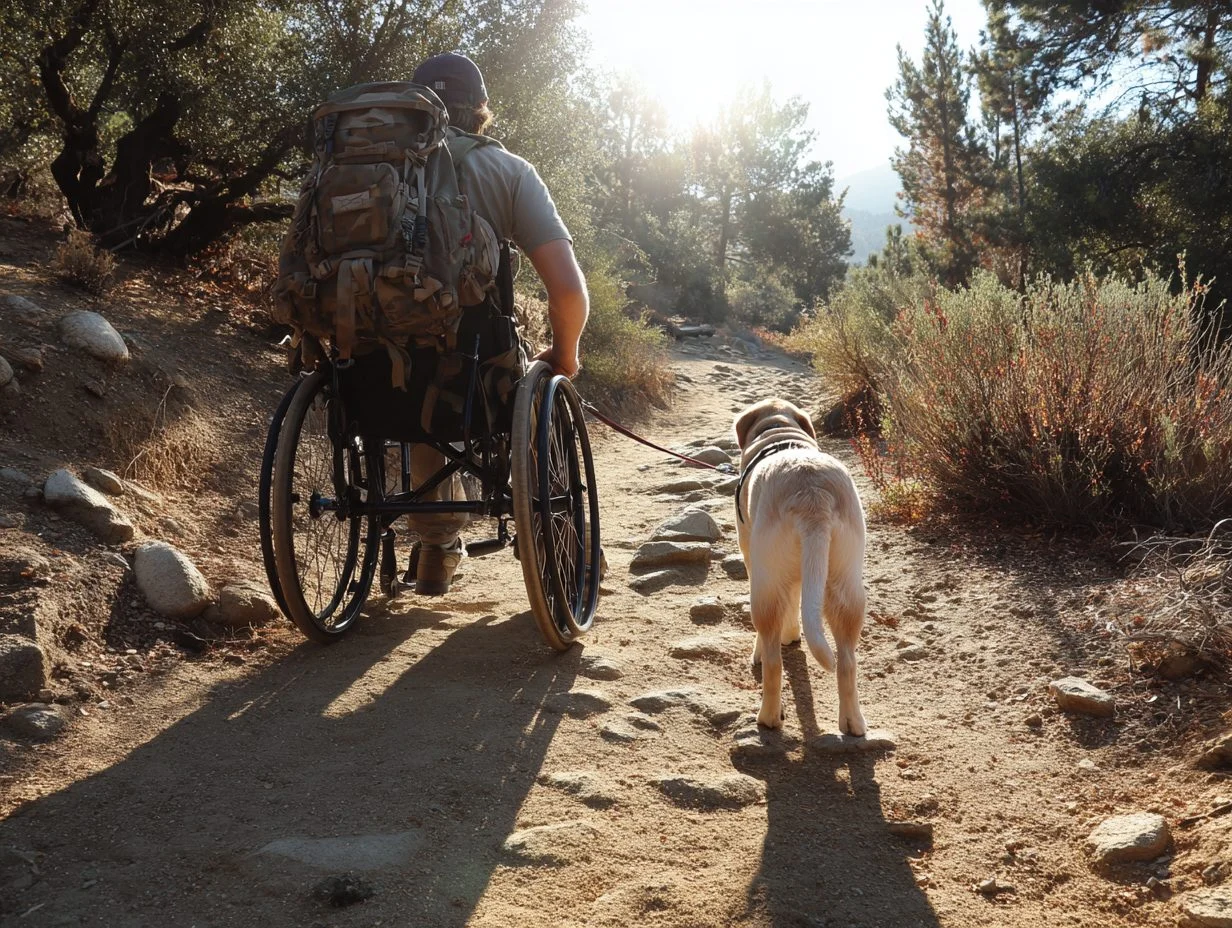
Southern California’s diverse landscape — from mountain lakes to desert oases to coastal bluffs — offers a surprising number of paved and accessible trails where handlers with mobility needs and their dogs can enjoy the outdoors together. Whether we’re talking about a boardwalk through a Big Bear wetland or a smooth loop around a San Diego canyon, these trails prove that accessibility and adventure are not mutually exclusive. This guide is part of our statewide guide to ADA accessible trails, focusing on Southern California, the Inland Empire, Greater Palm Springs, and the Desert Region.
Under the Americans with Disabilities Act, service dogs and guide dogs are permitted on all public trails. California law extends the same protections. These trails welcome handlers with mobility needs and their working companions.

Alpine Pedal Path, Big Bear Lake
The Alpine Pedal Path is one of the most reliably accessible trails in the San Bernardino Mountains. This fully paved, 3.2-mile path hugs the north shore of Big Bear Lake from Stanfield Cutoff to Serrano Campground, offering wide-open lake views framed by pine forest the entire way. The surface is smooth asphalt with gentle grades, making it suitable for wheelchairs, power chairs, and strollers. Dogs are welcome on leash, and the path is wide enough that passing other trail users is comfortable. Elevation sits around 6,750 feet, so summer temperatures stay mild compared to the valleys below. There is parking at the Stanfield Cutoff trailhead. For a shorter outing, we recommend starting from the meadow section near the midpoint, where mountain wildflowers bloom in late spring and early summer. The path connects to several lakefront picnic areas with accessible restrooms.
Stanfield Marsh Boardwalk, Big Bear City
Just east of the Alpine Pedal Path, the Stanfield Marsh Boardwalk crosses a protected 145-acre wetland preserve on the east end of Big Bear Lake. This flat, 1.5-mile out-and-back boardwalk is wheelchair accessible and offers some of the best birdwatching in the San Bernardino National Forest — great blue herons, bald eagles, and ospreys are regularly spotted from the viewing platforms. Dogs must be on a short leash to avoid disturbing wildlife. The boardwalk surface is smooth and level, with no stairs or significant grade changes. Wide-open views of the marsh and surrounding mountains make this a peaceful stop, especially in early morning when the water reflects the peaks. Parking is available at the corner of Stanfield Cutoff and Big Bear Boulevard, though the lot is small and fills quickly on summer weekends. We suggest combining this boardwalk with the Alpine Pedal Path for a full morning of accessible lakeside exploration.
Oasis of Mara, Joshua Tree National Park
The Oasis of Mara trail is the only officially designated dog-friendly trail in Joshua Tree National Park, making it a must-visit for handlers exploring the desert. This easy, half-mile paved loop begins at the park’s Twentynine Palms Visitor Center and winds around a historic fan palm oasis that sustained the Serrano people for centuries. The trail is flat, fully paved, and wheelchair accessible with minimal elevation gain. Educational signs along the route explain the area’s Native American history and desert ecology. Birdwatchers will appreciate the resident cactus wrens, phainopeplas, and Gambel’s quail. Dogs must be leashed at all times. The visitor center has accessible restrooms and parking. Note that portions of the trail beyond the oasis were damaged by heavy flooding and may be restricted — we recommend checking current conditions with the park before visiting. Desert temperatures can be extreme from May through September, so plan for early morning visits and bring plenty of water for both handler and dog.
Homme/Adams Park Loop, Palm Desert
The Homme/Adams Park Loop in Palm Desert is a flat, 2.2-mile loop within a 27-acre park that serves as the trailhead for the Cahuilla Hills trail system. The loop itself stays on level ground with desert views of the Santa Rosa Mountains and the Coachella Valley, making it accessible for wheelchair and mobility device users on the paved and packed-earth sections. Dogs are welcome on leash throughout the park, and there is a large fenced off-leash area at the base of the hills where dogs can run freely. Dog-friendly water fountains and waste stations are stationed along the route. The park also has accessible picnic areas and restrooms. Because this is the low desert, temperatures climb quickly after sunrise from April through October — we recommend arriving before 8 a.m. during warmer months and carrying water for both you and your dog. The flat terrain and mountain backdrop make this one of the more scenic accessible walks in the Greater Palm Springs area.
Mission Trails Regional Park, San Diego
Mission Trails Regional Park sprawls across more than 7,200 acres just eight miles northeast of downtown San Diego, and while much of the park is rugged backcountry, the Visitor Center Loop and Father Junipero Serra Trail offer accessible options. The Father Junipero Serra Trail is a paved path that follows the road alongside the San Diego River — flat, smooth, and suitable for wheelchairs. The 1.5-mile Visitor Center Loop is a wide, graded trail starting from the ADA-compliant visitor center, which features interactive exhibits on local ecology and history. Dogs must be on a leash no longer than eight feet throughout the park. Accessible parking, restrooms, and drinking fountains are available at the visitor center. We recommend stopping inside the visitor center before heading out — the exhibits provide helpful context for the native plants and animals visible along the trails. Spring and fall offer the most comfortable temperatures for extended walks.
Balboa Park, San Diego
Balboa Park is one of San Diego’s crown jewels, and its 1.4-mile Gardens Loop offers a flat, paved trail through some of the park’s most beautiful landscapes. The path passes the Rose Garden, the Alcazar Garden, and the Spanish Colonial architecture of the museum district, with surfaces that are typically at least six feet wide and grades of three percent or less — navigable for most wheelchair and mobility device users. Dogs must be on a leash no longer than eight feet throughout the park, including all trails and canyons. Designated accessible parking is available near the Alcazar Garden, behind the Organ Pavilion, and behind the Hall of Champions. For off-leash time, the park has two dedicated dog parks: Nate’s Point on the south side of Cabrillo Bridge and Morley Field near the tennis courts, both open 24 hours. Balboa Park is enjoyable year-round thanks to San Diego’s mild climate, but weekend crowds can be heavy — weekday mornings offer a quieter experience.
Oso Creek Trail, Mission Viejo
The Oso Creek Trail in Mission Viejo stretches 5.5 miles along a riparian corridor in south Orange County, with paved asphalt surfaces averaging eight feet wide and mostly gentle grades of five percent or less. Accessible parking with van-accessible spaces and striped access aisles is available at the trailhead near the Norman P. Murray Community Center, which also has restrooms. Dogs are welcome on leash, and water fountains with dog bowls are installed along the route. The trail passes mosaic art installations, a butterfly garden, a plant maze, and murals — there is genuine visual interest beyond the scenery. We recommend the southern section starting at the community center, where the paved surface is most consistent and the riparian shade from mature trees keeps temperatures manageable even on warm days. For a shorter walk, the 2.8-mile loop near the community center is a complete, well-maintained circuit.
Upper Newport Bay Nature Preserve, Newport Beach
The Upper Newport Bay Nature Preserve encompasses over 1,000 acres of coastal wetland in Newport Beach, and its Back Bay Trail provides a paved, accessible path along the south side of the bay. The asphalt trail offers uninterrupted views of the bluffs and estuary, with the 2.8-mile Back Bay Loop gaining only about 164 feet of elevation over its entire length. Dogs are permitted on designated trails and must be leashed. Accessible parking is available at multiple access points. The preserve is an important stopover on the Pacific Flyway, so birdwatching is exceptional — we have spotted great blue herons, snowy egrets, and brown pelicans here. The trail is wide and smooth, making it a strong choice for wheelchair users and handlers with mobility devices. Morning visits offer the best wildlife sightings and avoid the afternoon onshore winds that can pick up along the bay.
Santiago Creek Bike Trail, Orange
The Santiago Creek Bike Trail runs approximately six miles on a paved route paralleling Santiago Creek through the city of Orange and into Santa Ana. The asphalt surface is 10 feet wide with two-foot dirt shoulders on either side — one of the widest accessible trails in Orange County. The flat terrain follows the creek bed, making it suitable for wheelchairs and mobility devices. Dogs must be on leash at all times. The trail connects to three city parks — Grijalva, Yorba, and Hart parks — all of which offer parking and easy trail access. Yorba Park includes a dog park with separate areas for small and large dogs, making it a convenient stop for an off-leash break. The creek-side setting attracts various birds and provides tree shade along several sections, keeping the trail comfortable through Orange County’s warmer months. We suggest starting at Grijalva Park, where accessible parking and restrooms are available.
Lake Perris State Recreation Area, Perris
Lake Perris State Recreation Area in Riverside County sits about 70 miles east of Los Angeles and offers a paved loop trail that circles the lake. The trail surface is smooth asphalt, typically at least eight feet wide, with accessible parking that includes van-accessible spaces with striped access aisles off Via Del Lago at the north end. Dogs are permitted on the paved trails and must be on leash at all times — note that dogs are not allowed on the beach, in the water, or on Alessandro Island. The paved loop is the best option for handlers with mobility needs, as unpaved trails in the park can be rough. The lake is surrounded by granite hills that attract raptors and ground squirrels, and the water itself draws pelicans and cormorants. Summer temperatures in the Inland Empire can exceed 100 degrees, so we strongly recommend early morning visits from May through September. Bring extra water for your dog — shade along the paved loop is limited.
Know your rights on the trail
Under the Americans with Disabilities Act (ADA), service dogs are permitted in all public spaces, including trails, parks, and beaches — even where pet dogs are prohibited. California’s Unruh Civil Rights Act and Disabled Persons Act extend these protections further. A service dog must be under the handler’s control (leash, harness, or voice command) and housebroken. Businesses and park staff may ask only two questions: (1) is this a service animal required because of a disability, and (2) what task has the dog been trained to perform. They may not ask about the handler’s disability, require documentation, or charge extra fees.
Planning your accessible trail visit
Southern California’s biggest accessibility challenge is heat. From the desert floor around Palm Springs (where summer highs regularly exceed 110 degrees) to the Inland Empire valleys (routinely above 100 degrees from June through September), timing matters more here than in any other part of the state. We recommend starting any trail before 8 a.m. during warmer months and carrying at least one liter of water per person plus a collapsible bowl and water for your dog. Sun exposure is intense at every elevation — even Big Bear’s 6,750-foot trails get strong UV. Bring sun protection and watch for hot pavement that can burn paw pads; test the surface with the back of your hand before setting out. Desert trails like Oasis of Mara and the Homme/Adams Park Loop are most enjoyable from October through April, when daytime temperatures settle into the 60s and 70s. Coastal trails in San Diego and Orange County are comfortable year-round but can be foggy in May and June. Always check trail conditions before visiting, as desert flash floods and seasonal closures can affect access. Most parks listed here have accessible restrooms and parking, but amenities vary — calling ahead or checking the park’s website is the surest way to confirm current conditions.